
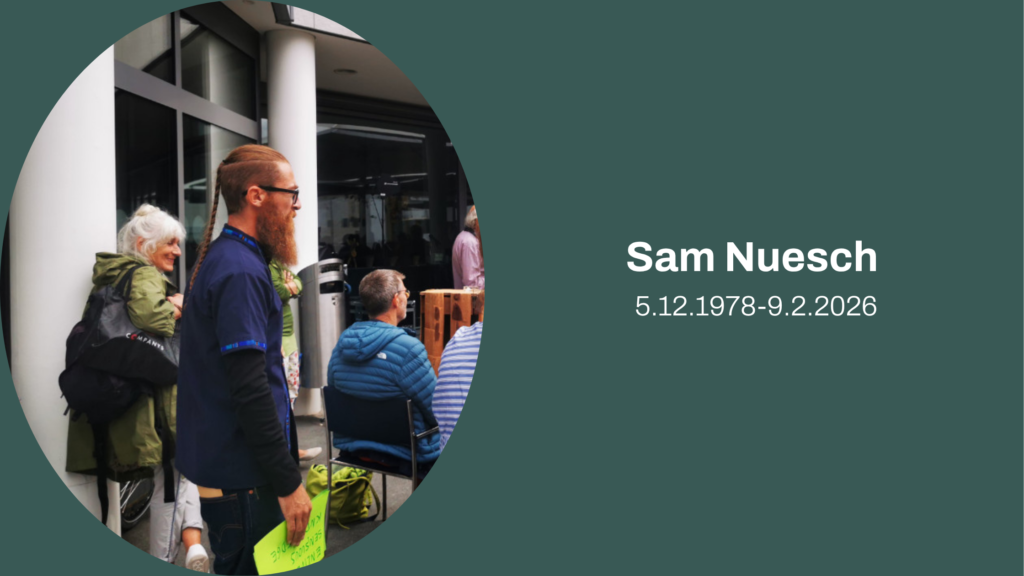
Discussed with Sam Nüesch, and part of a series posthumously published in his honor by Anaïs Sägesser & Julien Leyre (2026), this post – the second in a set of two – carries forward the thinking articulated and shared in a series of philosophical workshops held at the 2022 World Ethic Forum.
We hear it, we feel it, we know it. Our world is increasingly fragmented and increasingly polarised. These are two distinct patterns worth considering in parallel:
Fragmentation: our constitutional axis of resonance is disturbed. We are struggling to feel our inter and intra-connection with ourselves, others, nature and the universe. We struggle to feel how our health ties to planetary health, ties to food systems, ties to eco-social justice, ties to gender balance, and how those threads, as they manifest locally, ripple through the globe. Those connections remain real. We simply no longer experience them, or shy away from the fullness of our embeddedness into the land, as it can feel daunting, overwhelming, scary or even paralysing.
Polarisation: on each topic, we are increasingly organised around positions with no common ground. On climate: polluters are called out as criminals, or protesters are blamed for taking bread from hard-working people. On gender, some will claim that woke madness is destroying society, or it’s the patriarchy. Each camp in itself holds on to a specific narrative and set of opinions, forming bubbles of like-minded people. Between them, there’s a void and a lack of capacity to see how tight they are together, how much they reinforce each other
What if both patterns stemmed from a similar impulse, to simplify, cut, separate? What if it were all an attempt to manage complex living systems by stripping away their entanglement? A sort of morbid impulse, where we take life away so we can control the corpse. Or a possible survival mechanism of bleeding out complexity in order not to freeze and feel overwhelmed.
What we also know is that when we come together beyond rigid positions and listen to one another, there is often much more that unites than divides us, and suddenly more understanding can grow. We might realise that we share many of the same hopes and dreams or that our stories are more connected than we previously acknowledged. It is often ‘just’ the pathways to attain them or the deeper-lying fears and doubts that inspire our actions where we disagree or have come to different conclusions.
Where you stand, how you move
At the 2022 World Ethic Forum, three Firekeepers worked their way through those questions in a set of philosophical conversations (see the first post in this series).
Writing from the perspective of a Black Feminist, Minna Salami highlighted that we are not only facing a set of interconnected crises ‘out there’, but that we find ourselves in ‘a meta crisis, with the pain of entanglement and of the in-between’, echoing her book on Sensuous Knowledge.
Andreas Weber engaged with the question from the angle of biology and phenomenology. Seen through this lens, the binary impulse is an error of thought, applying the wrong categories to its object. Life does not organise itself into clean oppositions. We modern humans impose those on the living world, then mistake them for reality. To transcend those binaries, his invitation is for us to ‘dwell in the place where we feel stuck’, and resist the reflex of seeking premature resolution.
Finally, decolonial post-activist Bayo Akomolafe prompted us to look for the ‘fugitive path through the crack of the binary’. What matters is not so much what we do or not but rather how we cut through patterns. He ended the last philosophical session by inviting everyone to join in an ‘ecological prayer, where we fall to the floor together’, a way of staying with and giving space to the emergence out of silence to live once more within a universe that dances with itself
In spite of coming from different traditions of thought, those three thinkers share a similar drive: to define an ethics that is not about which position we take, but how we move with the problem. How we hold tension. How we resist premature closure.
Engaging with the neither/nor tradition
Those thinkers are not the first to dive into models and practices beyond the binary.
Neti Neti – ‘not this, not that’ – is an ancient yoga practice stretching back to the Upanishads, and carried forward in Vipassana meditation. Its aim is to loosen the grip of every concept we might reach for. Not to arrive at emptiness, but stay honest about the limits of any frame we use.
The Bhagavad Gita’s action/inaction (karma/akarma), as taught by Krishna to Arjuna, reveals both the presence of inaction within action (when acts are performed without attachment to their fruits, free of egoic reaction), and of action within inaction (when apparent stillness breeds karmic bondage through unchecked desire). This paradox liberates those who wish to act by transcending the duality of doing and not-doing.
Varga von Kibéd’s tetralemma, used in systemic constellation work, offers a four-way opening that dissolves the compulsion to choose sides. When a binary presents itself, it invites the practitioner to look beyond this, beyond that, beyond both, and beyond neither.
The tradition of the Zen koan centres on the figure of the paradox, which is not a puzzle to solve, but a door to walk through.
Critical ecofeminism critiques the interlocking dualisms (e.g. nature/culture, woman/man, wild/civilised) that underpin patriarchal, colonial, and anthropocentric domination, while refusing reductive resolutions or essentialisms. It cultivates relational, intersectional practices that honor situated differences and emergent alliances in the liminal space of ecological crisis
All invite us to build a relationship with the liminal space, the threshold where the old no longer holds and the new is not yet here. New meaning emerges only if we can resist the reflex to rush into clarity, dissolving the broad field of possibility.
Trickster tricks
In many traditions, the trickster is the one who refuses to play the game as given, and by doing so, reveals a different potential in the situation. Akomolafe’s practice offers a contemporary version of this attitude, woven into his coursework and education. He invites us to go out and do something weird, to step outside the logic of the expected and interrupt the automatic pilot of habitual response.
Drawing on Le Guin, Barad and others, he suggests that imagination is not decoration but orientation. How we imagine the world shapes what we think is possible in it. Therefore, cultivating post-binary imaginations is not an intellectual exercise; it is a survival skill.
The times are urgent, let’s slow down
None of this is possible in reactive urgency. When we are defensive or scanning for threats, we fall back into binaries. We pick a side. We reject whatever feels unfamiliar. Research on polarisation confirms what contemplative traditions have long known: complex, creative response requires a nervous system safe enough to stay open.
This is what Akomolafe means when he tells us to slow down in urgent times. It is not an invitation to passivity, but an embodied wisdom that knows the value of paradoxes and their elusive quality. If we hurry past the liminal space, we will reproduce the patterns we are trying to move beyond. What Weber calls enlivenment – the joy of aliveness, or what Buddhist traditions name mudita – is not a luxury. It is a condition of possibility for a future beyond fragmentation and polarisation. A future of interconnection, which we can experience by embracing sensuous knowledge – a term central to Salami’s thought.
Everything we do within the World Ethic Forum is inspired by a sense of radically shared aliveness. This is, in part, a mystical experience, in which the boundary between self and other becomes permeable. This experience is not just a spiritual aspiration for individuals aspiring to merge with the divine or nature. It is an ecological and a political necessity: the felt ground from which a genuinely post-binary ethics might grow.
The crack is here, on offer. The question is, how willing are we to move through it?