
A Living Inquiry
How do we come to a new, life-affirming relationship with ourselves, each other, and the natural world?
This question has guided our work at the World Ethic Forum (WEFo) over the past years. It is a lived inquiry: a process of unlearning, deconditioning, sensing, and rebuilding relationships within a web of life that has long been fragmented by human-centred systems.
At the WEFo, our research practice — Participatory Action Research (PAR) — is both inquiry and embodiment: being in practice together. It allows us to sincerely experiment with new ways of being and acting together, inspired by our diversity and grounded in ecocentrism, the understanding that all life holds intrinsic value. We see ourselves not as separate from the Earth, but as part of a living, interdependent community of humans and more-than-humans. And, we are on a continuous learning journey of edge-encounters, reflection, and further leaning into embodying yet-unfamiliar forms of being and acting, as individuals and as a wider circle.
From Firekeepers to Kinship
In 2022, we began our seven-year inquiry journey with a circle of more than 40 diverse people known as the Firekeepers: cultural workers, scientists, artists, spiritual leaders, and activists from around the globe.
Together, we explore what it means to surface and co-create the prerequisites for a culture of care and kinship.
This culture, as we see it, extends far beyond human relationships. It’s about recognising rivers, forests, animals, rocks and the subtle as members of a shared eco-social family. As the philosopher Andreas Weber writes, the world is alive. When we live from this awareness, care becomes a natural expression as well as a deep sense of belonging and shared responsibility.
A Conceptual Lens: Seeing the Whole Picture
To navigate this complex, multi-layered work, we’ve developed a conceptual lens — a map of interrelated dimensions that shape our practice and help us orient ourselves on our collective learning journey.
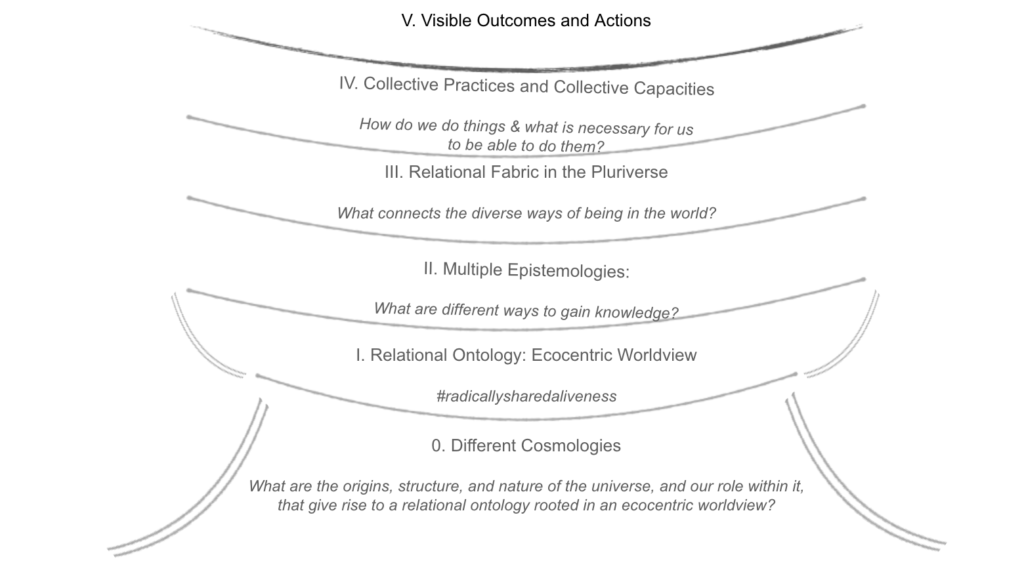
From the invisible to the visible, this lens unfolds in six layers:
0. Different Cosmologies – The origin stories that shape how different cultures understand life and reality.
1. A Relational Ontology – The ecocentric worldview: everything exists through relationships.
2. Multiple Epistemologies – Diverse ways of knowing, scientific and indigenous, analytical, embodied and intuitive.
3. Relational Fabric in the Pluriverse – The interconnected web of human and non-human life.
4. Practices and Capacities – The skills, awareness, and actions we cultivate to sustain care and kinship.
5. Visible Outcomes and Actions – The tangible expressions of our collective work.
This model helps us hold complexity, ambiguity and moments of liminality with greater ease. It reminds us that visible actions — meetings, decisions, prototypes — rest upon and are informed by deep, unseen foundations of cosmology, culture, and consciousness. In July 2025, we published a full peer-reviewed paper titled ‘Inquiry into Prerequisites for Co-Creating a Culture of Care and Kinship’ in RSD13, the journal of the Systemic Design Association hosted by the Oslo School of Architecture and Design, with greater depth and detail around our conceptual lens and the thinking behind it.
Two Core Prerequisites: Practices and Relational Fabric
Our early findings point to two interwoven prerequisites for co-creating a culture of care and kinship: practices and capacities, and the relational fabric that connects us to place, land, and one another.
1. Practices and Capacities
Care and kinship require embodied practice. These collective practices shape how we show up: how we listen, sense, dialogue, and co-create.
We’ve found that transformative change depends on developing collective capacities such as:
- Being in inquiry – Living the questions, rather than seeking quick answers.
- Being present – Meeting what arises, including discomfort and not knowing, with openness, curiosity and compassion.
- Being in connection – Cultivating relational awareness with self, others, and the more-than-human.
- Welcoming diverse ways of knowing – Honouring aspects such as intuition, storytelling, land-based wisdom, emotion, etc., as valid forms of intelligence and ways of gaining clarity.
- Co-creating and holding space intentionally – Cultivating trust and collective containers for transformation to emerge.
These capacities grow slowly through shared experience, reflection, and the willingness to be moved and changed by what we encounter.
2. Relational Fabric in the Pluriverse
The relational fabric — much like the mycelial networks in forests — is the living web that connects diverse beings and perspectives.
It has two main threads:
- Connection to land and place, which grounds our work in the physical and spiritual presence of the Earth as alive.
- Inclusion of diverse voices, human and more-than-human, that bring depth and wholeness to collective inquiry.
Building this fabric means listening deeply to stories, especially the ones that have been silenced — indigenous, feminine, non-Western, non-human. It also means recognising that the spaces we co-create are themselves participants in the process: the land, the air, the sound of water, the room’s architecture, the stories and histories of the place, they all co-shape the collective field.
Learning Through the Firekeeper Circle
Our ongoing work as the Firekeeper Circle has revealed and refined further layers that systemic change requires. We see them as enabling conditions, like :
- Time for deeper pattern recognition – Slowing down enough to see what’s really moving beneath the surface and in the depths.
- Navigating power and privilege – Bringing awareness to extractive and oppressive, and often subtle and hidden, dynamics in groups, including our own.
- Diverse representation – Ensuring the circle mirrors the richness of the pluriverse, while acknowledging we are never able to fully represent all voices equally
- Building trust and common ground – Establishing a shared sense of belonging and safety before taking action.
- Intentional process design and social architecture – Creating spaces that enable emergence, dialogue, and embodied learning.
These are living principles: the architecture of a relational ecosystem that can sustain transformation.
Towards a Life-Affirming Future
In the end, our work at the World Ethic Forum is about contributing to reweaving the torn and fractured fabric of life and enhancing our awareness of our intraconnectedness, including for the yet-unborn.
Through being in practice together, we are learning how to listen again — to the land, to each other, to the silenced and unseen – and acknowledge what is, even when it causes distress and doubt, or when it triggers edge-emotions. We are learning how to practice radically shared aliveness in the here and now, with the diversity present, with ourselves and each other.
And as we do so, we are discovering that a culture of care and kinship is not something we can only long for, design or impose. It is something we can only cultivate — together, with humility, presence, and love.
The above article is based on the following peer-reviewed conference paper: Ritter, L., Gyger, M., & Sägesser, A. (2024, October 12–26). Inquiry into prerequisites for co-creating a culture of care and kinship [Conference session]. Relating Systems Thinking and Design Symposium (RSD13), Oslo School of Architecture and Design, Oslo, Norway & online: