
Co-authored with Sam Nüesch, and posthumously published in his honour by Anaïs Sägesser & Julien Leyre (2026), this post – the first in a set of two – carries forward the thinking articulated and shared in a series of philosophical workshops held at the 2022 World Ethic Forum.
At the World Ethic Forum 2022 public event, Anaïs & Sam were invited to host a series of philosophy sessions with Firekeepers Mina Salami, Bayo Akomolafe and Andreas Weber. They called this exploration ‘Beyond cosmological narcissism. Thinking with rivers, dancing with mountains, making ourselves eatable. Explorations of radically shared aliveness.’[1]
As we continue to live through a tangle of socio-ecological crises, the questions raised in this session have retained their relevance. We take it as a premise that the current trajectory of our civilisation includes a number of risks with enormous potential impact, and rising probability – or as the data suggests: that we are already far enmeshed in a situation of our own making that poses the threat of civilisation collapse, up to the point of human extinction.
Activists of many types and ilk are working to bend this trajectory. Many are doing so with growing frustration and despair. Some are even giving up. Their frustration comes from the fact – or the perception – that despite all knowledge, insights and efforts, ‘the system’ doesn’t seem to change for the better. Or at least, not in the way we feel is needed – not with the swiftness, timeliness, and resolve we would like to see, or that we feel is required to meet the interlacing challenges we face.
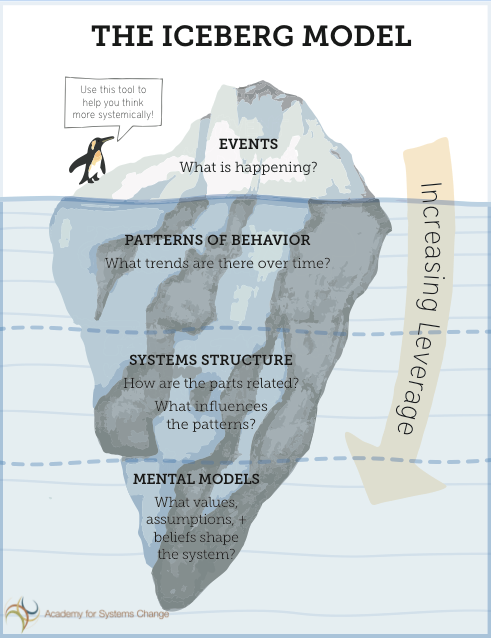
In the layered architecture of what we call ‘the system’, concepts like ‘mental models’, ‘worldview’, ‘culture’, and ‘values’ are often given a prime position/place. Take the Iceberg model – a centre piece of every beginners’ course on systems thinking – and you will find a layer lying deep down below the waterline holding things like worldviews, beliefs, perception or thinking. The suggested implication of the model is that changes at that level would have tremendous leverage effects. If we could only change ‘our worldview’, ‘our thinking’ or ‘our beliefs’, we could indeed solve such existential challenges as mentioned above with more aligned, congruent and meaningful approaches for the long-term – together.
So, if we want to have a go at doing just that, what would it actually look like? This question calls for a pause, to lay out what is meant here by the loose terms ‘worldview’, ‘beliefs’ or ‘thinking’. In this context, this will include pretty much all that philosophy might consider – from ontology, to cosmology, to epistemology, ethics and more. For good measure, we might throw in psychology or even the full array of the cognitive sciences. That lower layer of the iceberg includes all our assumptions about who we are, what the world is, how we come to know what we know, what we should do about all of it, and why it matters. It even includes the way we feel when considering those questions, about ourselves and other people, and about the world, including other beings, rivers, mountains, moons, suns and stars.
When we consider it this way, ’changing our thinking’ or ‘changing our beliefs’ suddenly seems like a rather daunting task. But it also helps in making sense of why this might have a ripple effect: it is no less than changing our relationship with everything around us. Or rather, in the present times, rebuilding a healthy relationship with everything else. At least in part, the present ecological crisis comes from severe alienation or a disturbance in our constitutive axis of resonance (Rosa 2016).[2] We have lost the felt connection to ourselves, others, nature and the universe. We no longer perceive ourselves as part of the natural world, or part of life. Rather than living ‘as’ nature, we live ‘off’, ‘with’ or at the very most ‘in’ nature. [3]
Our processes and cultural practices are far from taking other species, ecosystems or landscapes into consideration. To give one fairly clear example, we slaughter billions of fellow animals each year because we like the taste of meat. We cut and burn enormous areas of old-growth forests, we fill rivers and lakes with pesticides, we fish recklessly, and we don’t seem to care. It’s not our business, not our suffering, not our concern. We say we ‘love’ chicken, beef or pork. What we really mean is that we like to eat the dead bodies of chicken, cows and pigs, after the miserable lives we impose upon them. Are we not related to these chickens, these cows, these pigs? And if we can feel so much distance between ourselves and those living beings we believe we depend on for food, how much more will we feel distant or separate from the forests, rivers, oceans, and mountains around us?
This is where we come to the title of this post, and the series of workshops that gave rise to it. Let us spiral into deeper and deeper connection with the mountain, as we go through a series of four worldviews reflecting different ways of connecting to it, what might bring us to care for it, or how we might dance with it.
We might start with the current dominant worldview of anthropocentrism, where humans are the central object of concern, but everything else does matter to the extent that it impacts humans. If a mountain is sacred to indigenous people, they may suffer when the mountain suffers. Mining it goes against important spiritual principles, or it is a disgrace. There may be material grounds for this sense of connection. After all, the mountain is made of the same stuff as we are. Some of our ancestors have become part of the mountain, and some of the mountain has become part of my own cells. We are all stardust. We are all born of this matter-mother. The flows of materials that form all bodies, all mountains, all rivers, clouds, books and cars – they go on and through pretty much everything. This bubbling river forms what is here – and then re-forms. We might be prompted to ask then, why is it that no mountain is sacred to us WEIRD people [4] ? Or are they? Does an organisation like Mountain Wilderness, trying to guard against loud, invasive tourism and the like, deem mountains to be sacred? Is this what motivates them? Still, down in the depths of the iceberg, if our care for the mountain depends on human suffering, human rules, even a sense of connection with the matter that humans are made of, we are operating from an anthropocentric worldview.
And of course we should make a difference between ourselves and the mountain, shouldn’t we? After all, we are conscious beings. Are mountains, too? We perceive. We experience music and express our feelings. Do mountains? It seems like those questions get us nowhere, except – what if we offered a further shift in perspective? What gets a little closer to relevance is the matter of suffering. We suffer. And the mountain? This line of questioning stems from a different worldview: pathocentrism, where sentience is the defining feature inviting care. Here, something suffers because it has the ability to feel pain and is not healthy or is treated in unhealthy ways.
We might not directly think that a mountain can suffer. Yet there is another way we might relate to the mountain as a subject of care: if we think of it as alive. This takes us to a third possible worldview, biocentrism, where aliveness is the root of care and connection. When we think of an ecosystem, we sense that it might be healthy, or less so. And the mountain is itself part of an ecosystem, made up of all the plants, the animals, the fungi, and the myriads of beings from the microbiome that have their life on the mountain. If the mountain is mined, this might diminish the health of the ecosystem. If the mountain is part of the web of life, we might say that it can suffer. Even if we refuse the metaphor, we might say that the mountain is an intrinsic part of life, therefore not all that different from us, and worthy of care.
Now, let’s take a further spin down the spiral of worldviews, into the most expansive form of connection with the world. Clearly, we make a distinction between ourselves as complex creatures with rich lives – including an occasional dance – and a static, inert background against which our lives unfold. We live our lives assuming that mountains can´t dance. But don´t they? Could it be they are just dancing along another rhythm? Think of it as a reeaaaal eeaaaaaasy Chiiilllll. Where each minor move takes thousands of years or more? Now, maybe they do dance in a way. Just not in the same way we do. This is now closer to ecocentrism, or holism, extending beyond sentience and aliveness to care for everything that is part of the world around us.
And so we move through the four major nature philosophies from Anthropocentrism, where care ties to ensuring autonomy of the (human) subject, to pathocentrism, in which care ties to all beings with the ability to suffer, to biocentrism, where care lies within aliveness, and the associated capacity to die to ecocentrism, or holism, where the care extends to ensuring the integrity of the functionality of entire ecosystems.
The World Ethic Forum operates along a worldview centred on holism/ecocentrism, more particularly a version of it called kincentrism, drawing on indigenous thinking, where mountains, rivers, animals, people, and plants are all seen as kin. This is a holistic positioning, without a centre. It frames humans not against nature, but as an integral part of nature, with a critical role in ecosystems. Humans themselves are nature. To fully embrace this role, it is essential to embrace our entire being with all our ways of knowing.
This acknowledgement of our full inclusion in nature opens two broader streams of thinking.
The first concerns a truly integral and systemic understanding of health. Here, health means whole systems health: a salutogenic, regenerative design of cultures – including our economies, politics, and worldviews – so that all forms of life may flourish. This includes ecosystems and the diversity of species that sustain planetary vitality. In this light, radically shared aliveness becomes synonymous with planetary and systemic health. We cannot be healthy if other parts of the planetary whole are unwell, for we do not stand apart from the Earth: we are the Earth. This is similar to the concept of Planetary Health, which has emerged in recent years.
The second stream points toward the emergence of a new ontology and a new cosmology. A decentralised eco-social movement or practice that nurtures both wisdom and vitality. On the one hand, it would cultivate integrity: critical thinking, awareness of bias, self-correcting capacities, and ethical maturity. On the other hand, it would orient itself towards aliveness, towards living the most vibrant, meaningful, and dignified lives possible: a way of being guided by buen vivir, or the art of living well in relation to all life.
As part of the capacities and practices cultivated within the World Ethic Forum, maybe at the very core of it, we count an expansion of our capacity to care, and our perception of inter- and intradependence. This is a deep shift in perception: that our health and the health of our planet are not separate. We depend on the world, which in turn depends on us, stepping forward with care at the center. As this realisation lands, we relearn our role too: it is not that the world does not require humans, we are part of it, too, we belong to planet Earth.
Among the preconditions for radically shared aliveness, then: learning to dance with mountains.
[1] Original German title: ‘Mit Flüssen denken, mit Bergen tanzen, uns essbar machen. Eine Erkundung der radikal geteilten Lebendigkeit.’ ‘We will dance with mountains’ is also the title of a course by Bayo Akomolafe.
[2] To mention some of the aligned thinkers, see for example Otto Scharmer and the Presencing Institute, or Nora Bateson and the Warm Data Labs.
[4] WEIRD: Western, Educated, Industrialized, Rich, and Democratic. More in this paper, or in summarised form.