
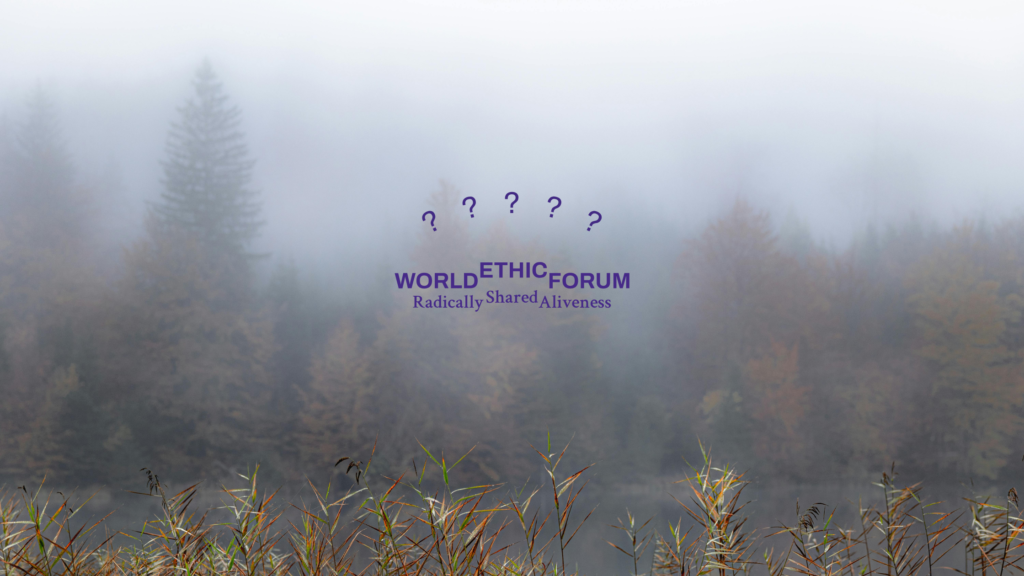
Our kinship group gathered online once more. Different moods were there, yet the familiar hum of shared inquiry filled the digital space. The conversation circled back to something old and still alive: our name.
Since the Firekeeper Circle gathering in Pontresina in 2024, it has been clear that the name ‘World Ethic Forum’ doesn’t quite fit us. What had been voiced in one-on-one conversations or in side conversations among a few since 2022 was now named openly and addressed in the full circle. It was the next stage of approaching an elephant in the room – relieving or confronting for some, indecisive or neutral for others. A tetralemma that had festered for a while surfaced now in our midst. A chance to address it and not get polarised by it as a group. So here we are, being with and holding space for the diverse tensions it makes visible.
We are not representing ‘the world’, nor are we about ‘one ethic’, nor have we gathered in a ‘forum’ style. There is so much more richness, diversity and nuance. And yet – we are still living under this name. Perhaps because naming something before it is ready to reveal itself feels like forcing it into too-small a skin?
For now, we focus on what is yet to come, and stay with ‘World Ethic Forum’, sensing into the fog, trusting that new contours will become visible in their own time. Being OK with the in-between – neither rejecting where it came from, nor rushing too early towards a solution. Going, instead, towards the concrete. Embracing more both/and.
Our first logo had come easily – a simple leaf, light and unpretentious. It seemed to fall into our hands without effort. It felt light and playful. Now, as our work seeks deeper form, this too is shifting. The new logo introduced at the end of 2025 carries more structure, a sense that something is taking shape. Focusing on words only. Not daring to give it form. And still – we know it will change again.
The same goes for the claim of ‘Radically Shared Aliveness’ – a phrase that originated from the creative exchange between Linard Bardill, Martin Ott and Andreas Weber. It has spoken for us beautifully, for a time, but we also recognise that it was not born of our communal hearth, not from all our voices gathered around the same fire. It was part of the call that invited the first Firekeepers, but since then, something else has unfolded – emerging through the cracks of our shared centre.
This acknowledgement matters. It opens the space for a soundscape woven from the many timbres now present – one that holds the friction that aliveness brings with it.
‘I am life that wants to live in the midst of life that wants to live.’ (Albert Schweitzer)
Amid the unifying and generative forces we feel called to tend, we must also name and move with what is dying, separating, decaying, or colliding. It is not all beautiful. It’s also messy, full of discomfort and encounters with the abyss. Yet being present with it all, and witnessing that commitment lived by everyone, is a deep gift to life, with life, for life.
What stood out in our kinship call was less about answers and more about the quality of our being together and how we stayed present in deep listening. Between trust and critique, between clarity and confusion, we practised the art of staying with difficult questions – about identity, naming, liminality, and the discomfort of not knowing. We practised the art of dancing with and between the poles. Asking the questions again and again, keeping them alive, allowing them to guide us. This is how the unfolding path might emerge more visibly for us. This is how we might follow it.
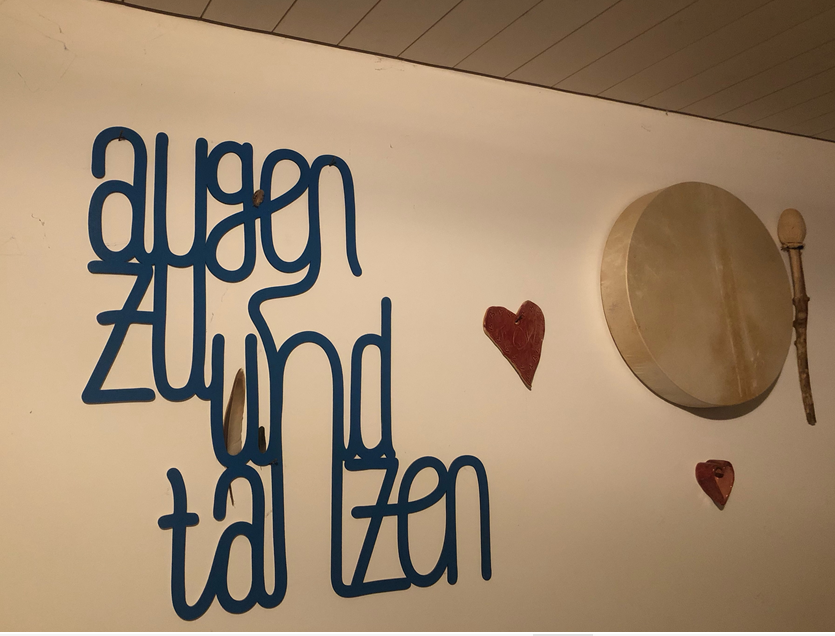
Photo: Augen zu und tanzen: ‘close your eyes and dance’. The quote was visible in the background of Ivo Hutzli during the online call, and was referenced several times.
It is a tender dance. Being in the fog feels ok but it must not become arbitrary or leave us turning in circles. It is an invitation to keep the warmth and the trust alive in the space of ‘not yet’. And to keep on nourishing one another, nourishing the fabric that has woven and is weaving itself between us.
From the first leaf to the nebula, we practice again and again the quality of openness and staying available. To let go of what we thought we knew, to make space for what wants to be born and become tangible next. Or as poet Rilke wrote in the Duineser Elegien:
[…] We construct it.
It falls apart. We reconstruct it
and fall apart ourselves. […]
German original:
[…] Wir ordnens. Es zerfällt.
Wir ordnens wieder und zerfallen selbst. […]