
2024 marked the third in-person gathering of the World Ethic Forum in Pontresina, beneath the nearby Dragon-shaped Mountain range and the peak of Piz Padella. Together, we continued our inquiry, with “The Heart of Change” as our topic for the year.
One core area of focus in 2024 was how to converge across our differences, holding complexity and beauty simultaneously. We explored ways to embrace those tensions as vital forces in collective transformation and leaned into different practices to support resolving, easing, and transcending them, at both a personal and a group level.
We acknowledge that tensions, if not named and addressed collectively, can contribute to the festering of a sense of separation and the perpetuation of deep hurts, sometimes extended over centuries. By listening to wounds with care, honouring autonomy while nurturing coherence, and calling upon joy even in moments of friction, we (re)discovered that tension can be a catalyst for vitality and shared clarity, not only a threat to it.
Connection to Land and Place
In the weeks and months leading up to the gathering, we adopted a sustained practice of connecting to the World Ethic Forum as a being, as well as the land and the spirit of the place where our gathering would happen once again. This unfolded through contemplative work and energetic alignment. For example, before the start of the gathering, Luea & Anaïs reconnected with the life-affirming energies in the Rondo, the building where the gathering took place, which have guided and informed them since before the first gathering in 2022. Offerings, prayers and rituals were held at the local stream and diverse outdoor places that were rich with meaning, spirit and presence, embracing a practice that several other Firekeepers had also invited since the very first gathering.
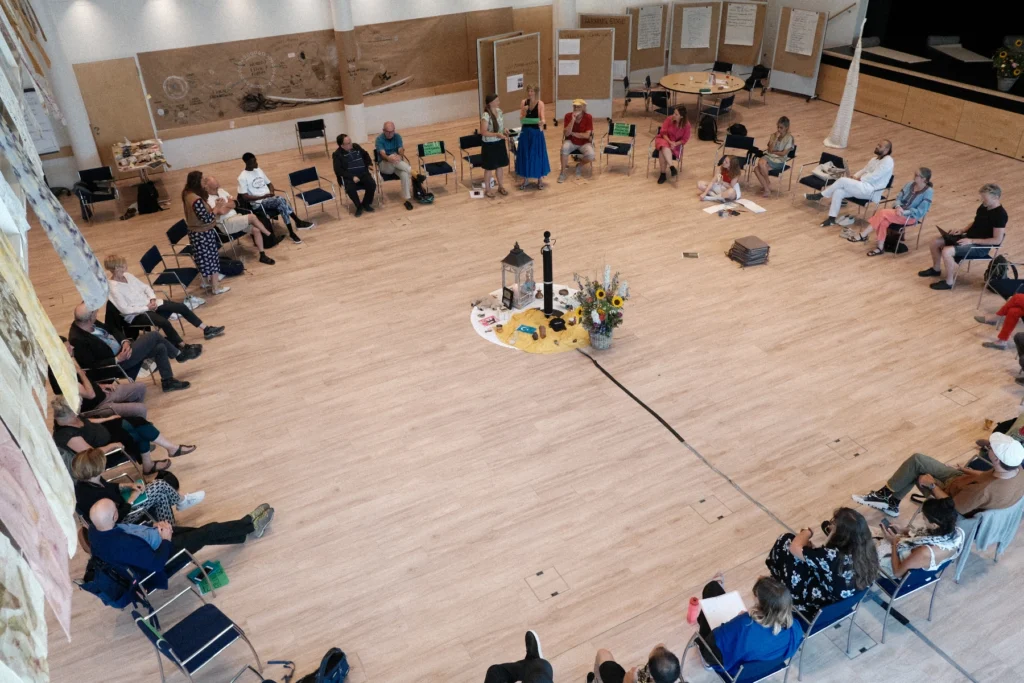
The circle forming the centre of the gathering itself was energetically prepared, using the same stones that have held the space across gatherings to ensure continuity. The elements – fire, water, earth and air – were intentionally brought together in ritual as a consious opening, and tended to throughout the gathering.
During the opening ceremony, led by Erin, Madlaina, Rutendo, and Lucia with Odine, music was played on a flute made from glacial mud sourced locally, accompanied by local spring water, fire, and air. Together, those elemental presences created a shared ritual ground.
That allowed the relational field to be supported and deepened through the physical space where our gathering was held. The spatial concept was designed by Sonja Schenkel, in collaboration with a circle of artists – locally and globally rooted – whose practices are grounded in care, resonance, and expressions of radically shared aliveness.
Verena Nussbaumer’s walnut prints and ecoprinted textiles, which hung into the space, invited reflection on the delicate threshold between the foreign and the familiar. The Kaffeeteppich, created by Sonja Schenkel and Creative Hands, offered a woven ground of global trade and local presence, where the ‘here’ and ‘there’ meet. Cantos al Agua by Jehisson Ywiku Santacruz brought sonic offerings to water and mountain, rooted in indigenous cosmologies of connection and care. The community clay sculpture by Madlaina Fontana, shaped from local earth, invited tactile participation – while Sgraffito constellations, guided by the local heritage, and Chrysalis sculptures, both by Sonja Schenkel, opened pathways for protection, transformation, and trans-temporal connection. Her Chrysalis sculptures also held a specific presence in the room and co-held the energetic space.
Together, those works opened up spaces shaped not only by human intention, but also by the presence of more-than-human beings, through materials, symbols, gestures, and elements from the surrounding valley. Throughout the venue, those artworks and installations served as touchpoints for deeper inquiry: threads of textile, sound, silence, movement, and generative scribing ran through the space, creating conditions for emergence. These were part of an embodied inquiry into how space shapes consciousness – how place, material, and ritual become co-facilitators of our shared becoming.
Relational Fabric of the Pluriverse: Including Diverse Voices
Including diverse voices is a core principle that runs through the thematic strands of WEFo. Each thematic strand approaches this from a different angle, and each gives expression to important aspects of what the inclusion of diverse voices may require, look like and entail.
Kinship invites the presence of more-than-human voices. DEI & Decolonisation centres the voices of those who have been structurally oppressed, marginalised, or excluded. Healing & Reconciliation supports the conditions for healing, reparation and re-integration, especially for those whose voices have gone unheard for far too long.
To mark the importance of this inclusion, and acknowledge their absence as a first step, in 2024, once again, we installed four empty chairs in the space: one dedicated to more-than-human voices, one to the future generations, one to Firekeepers who were not physically able to attend, and one to former team members, reminding us of the broader web of life and interdependence we are part of and their respective contribution to the work that makes us gather.
One powerful moment of embodied inquiry came through the initiative of two Firekeepers, Mongy and Ale, whose practices are rooted in DEI and decolonial work. Together, they offered a privilege walk. A privilege walk is a well-known method in social justice work going back to Peggy McIntosh’s seminal work on White privilege. This practice invited participants to reflect on where we each stand in relation to systems of power, access, and belonging. It revealed cracks and blind spots, and offered a mirror to the visible and invisible structures shaping our shared field. For some, this was very insightful, and for most also painful. This embodied exercise, by exposing power, access and belonging, showed in a very visible way the cracks and divides in our group. It brought up a difficult question: to what degree do we create learning opportunities for some (the ones with privilege) at the expense of others? And once these cracks have been revealed, how do we process and transcend them together? As we acknowledge that revealing is only the very first step.
On the following evening, and to a certain degree also as part of our ‘digesting’, participants were invited to the screening of the documentary Soundtrack to a Coup d’État by Johan Grimonprez. Interweaving archival footage, jazz, and political history, the film traced the entanglements of colonial violence, cultural resistance, and imperial intervention specifically in relation to the UN and the murder of Patrice Lumumba. This collective viewing and the conversation that followed opened space for reflection on how these historical forces live on in the present, and how we might carry, challenge, or transform them within ourselves and our communities. It prompted further reflections on privilege, together with a sense of helplessness, particularly since some of the Firekeepers strongly count on the UN with their engagement and their activities. To acknowledge through such a documentary how power plays out behind the scenes dismantled at least part of the past of this crucial institution.
These shared moments created a tremor in our relational fabric. At the end of the gathering, a call for new structures emerged to support this ongoing work. A Firekeeper Curation Circle was formed with the intention of deepening the intentional weaving of diverse voices into the heart of the gathering. Voices for meeting in other settings also led to the idea of looking for another location in 2025 in Switzerland, while the DEI & Decolonisation thematic strand proposed that the 2026 meeting could be held in Kenya, one of the eleven countries of the Nile basin. This is a bioregion where Firekeeper Mohamed El Mongy is active, and where we have deep existing connections through our partner organisation Nile Journeys.
Refining the inquiry: Collective Practices and Capacities Observed
The gathering was an occasion to reach greater maturity in the articulation of our inquiry. This gave rise to an academic paper where we describe our conceptual lens, under the title Inquiry Into Prerequisites For Co-Creating A Culture Of Care And Kinship (Ritter, Gyger, Sägesser). Feedback from the Firekeepers, especially regarding the integration of different cosmologies, was integrated after the gathering for the final paper submission. You can read more about it here.
The gathering also crystallised a new understanding of the collective practices and capacities that would form the preconditions to a culture of care and kinship. In 2023, we had noted four collective fields of practice that have continually called our attention and care. During our time together in Pontresina in 2024, through reflection and shared presence, we recognised the need to expand and amend them. This gave rise to a more nuanced constellation of seven collective practice fields:
- Celebrating Radically Shared Aliveness
Joy, awe, and compassion as essential practices — honoring the vibrancy of being alive together and the deep nourishment that celebration brings. - Cultivating & Enlivening a Shared Ecosystem Understanding
Nurturing a living-systems awareness: interweaving our experiences, recognizing interdependence, intraconnectedness, and co-creating life-conducive structures. - Shedding Light on Less Visible Structural Dynamics / Root Causes
Making the implicit explicit — revealing hidden assumptions, systemic patterns, and unconscious biases, while shifting perspectives and bringing clarity to underlying dynamics. - Transformative Practices: Surrender, Letting Go, Openness
Welcoming what wants to emerge through us — surrendering control, embracing openness, and allowing shifts in meaning and perception to unfold. - Looking at Our Wounds
Engaging courageously with grief, death, suffering, and difficult emotions — creating space for healing through acknowledgement, care, and presence. - Metabolising / Alchemy / Learning
Actively transforming what we encounter — not just enduring, but digesting, integrating, and evolving through deep learning and inner alchemy. - Being With — Coholding in Uncertainty and Turbulence
Practising presence with ourselves and each other in times of tension and not-knowing — coholding complexity, staying with what is, and cultivating grounded relational presence.
By naming these collective practices, we by no means claim or pretend that we have reached a mature, conscious or embodied state in relation to them, neither as individuals nor as a group. Rather, we see that they offer learning edges for us to engage with, learn from and deepen into practice. We see them as essential, if not critical aspects that not only deserve but require our attention, as part of our overarching inquiry.
Navigating Tensions: Wounds, Autonomy, Friction
Through the gathering, some of our deepest learning came from moments of tension.
Different wounds surfaced, around privilege, historical trauma, or relational rupture. We also wrestled with the tension between individual autonomy and collective coherence as well as between the immediate energy of projects and the slow pace of emergence. Other tensions appeared around emerging proposals to engage in prototyping work. Rather than seeing these forces as oppositional, we explored how they might dance together.
At some moments, we fell short. Urgency, fear of conflict, or discomfort with the unknown led us to bypass tension or retreat into familiar habits. Language barriers and differing expectations occasionally hindered deeper connection. In hindsight, we wish we had committed to tending to some of them with more spaciousness and care. This would have required a collective shift from urgency and expectations to presence, from fixing to witnessing. Yet these moments, too, became part of our learning. We recognised how personal dynamics mirrored collective patterns: the micro and macro continually informed one another. Recognising the fractal nature of our work reinforced the felt interdependence of our practice fields.
We came to see once again that tension is not a problem to solve but an energy to work with. At times, we leaned in, discovering new insights and deeper intimacy. At other times, we sat with the tension, letting it exist without pushing for resolution or trying to diffuse it, though sometimes, we avoided it entirely by withdrawing or failing to make space for it and the vulnerabilities it reveals. All approaches offered lessons in humility, patience, and the slow work of culture change by being mirrored, embracing ‘failure and daring to rebalance back together’.
Through all of this, celebratory gatherings – whether formal or spontaneous – were vital to maintaining energy and cohesion. These moments reminded us that laughter, song, and awe are not peripheral, but central to shared aliveness.
What followed the gathering were two wonderful days of a public event dedicated to the Heart of Change, where many tensions found their place to be addressed with a wider circle. The event also gave Firekeepers the opportunity to participate in one another’s practices and share a moment of immersion.
Honouring the snapshot
This chronicle is not a conclusion but a snapshot of a living process. We continue to learn how radically shared aliveness can take root in our communities and institutions: not through perfection and harmony, but through deep presence with all that arises. May we keep leaning in, holding each other through the discomfort and the delight, and walking this path with tenderness, bravery, and joy.
This text is based on a draft written by Anaïs Sägesser and Luea Ritter, informed by observations by Ruth Förster and Randy Maellerat, following the third in-person Firekeeper Circle Gathering in Pontresina in 2024.