
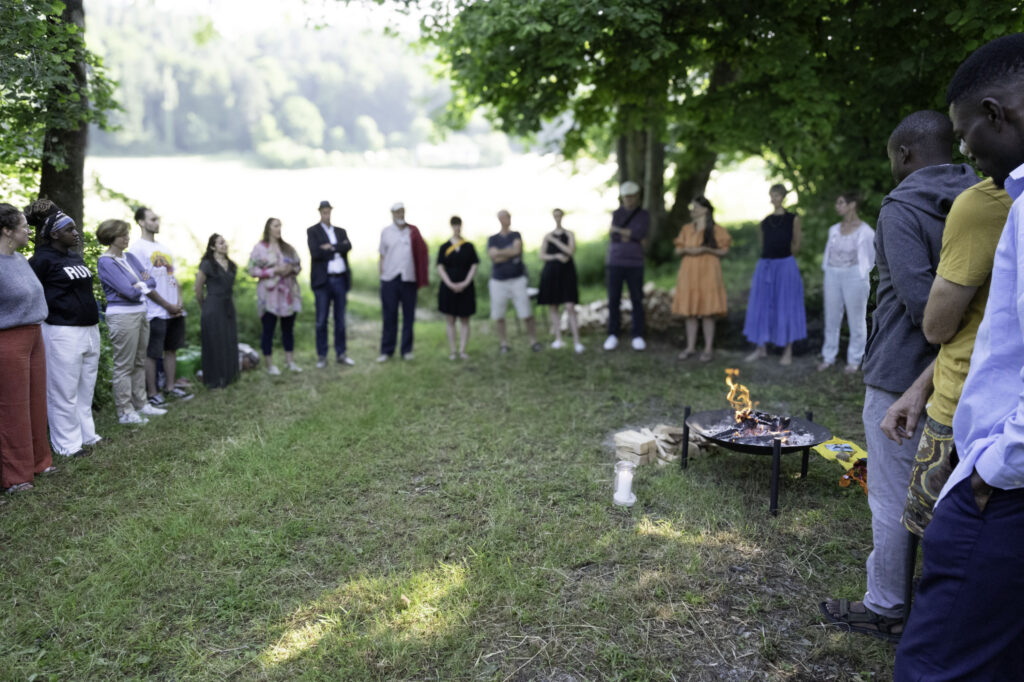
The 2025 gathering marked the Midway point of the initial 7-year arc for the World Ethic Forum’s Firekeeper Gatherings. Physically, this gathering was marked by a movement from the higher lands of the Engadine (Pontresina), where we came together the previous three years, ‘down’ to Männendorf, next to the lake of Zurich (all in Switzerland on the European continent). Cyclically, it signalled our entry into the fourth season. It was a time to take stock, integrate, ferment, sense-make, heal and gather strength for what is yet to come. In line with this, our calling question was: “What compost have we built, what needs care and wants to be seen and named in the circle, and what is now longing to emerge — asking us to listen, discern, and align our focus for the arc to come?”
The 2025 Firekeeper Circle Gathering invited participants into living practices of kinship: ways of being together that transcend language. Together, we inhabited our calling question through presence, ritual, and attentiveness, exploring how kinship can be felt and practised in the spaces between humans, more-than-humans, and the unseen, not as an abstract notion, but as a lived, embodied, rhythmic and continually renewed relationship with the web of life.
Building Relational Presence
The gathering and subsequent months of reflection revealed kinship as an evolving capacity for being with: with each other, with land and fire, with ancestors and descendants, with paradox and transformation. Through daily check-ins, circles of presence, and through the acts of co-hosting and co-holding, kinship was woven into the fabric of the gathering. These gestures cultivated mutual trust and belonging, creating a space where the visible and invisible could meet.
A physical burning fire ritually lit up at the start became the beating heart of our gathering and shared experience. It served as a relational centre of gravity around which care, attention, and shared responsibility were continually renewed. It was tended to continuously throughout the three days: day and night, at least one of the firekeepers took on their role in a literal sense, firekeeping. Through acts of care like cooking together, shaping clay from local earth, preparing ceremonial spaces, and maintaining the sacred fire, kinship was enacted. Each act revealed that relationship is sustained through tending, offering, and shared labour.
Firekeepers who were not physically present participated digitally for the social field resonance practice, expanding our understanding of presence and belonging. Their distant flames demonstrated that the web of kinship need not be bounded by geography and locality. Also, Firekeepers who could not attend in-person proposed questions and poems previously to the meeting, which were shared with everyone, ensuring the connection was upheld and honoured. Collective moments of reflection and ceremony across physical and digital space wove a fabric of connection that transcended proximity, reaffirming that kinship, once kindled, knows no bounds.
The continuity of relational presence was also felt through the materials and symbols that returned from past gatherings: the stones and round cloth that had held the circle since 2022, a bowl of water (which included water from Pontresina), and ashes from a ritual of burning grief in 2023. These elements linked the 2025 gathering to a lineage of practice, embodying a continuity that transcends time and form. In this sense, kinship extended not only across beings but across years as an ongoing practice of remembering and renewal.
Including Diverse Voices
Our 2025 inquiry into kinship opened new layers of reflection on the inclusion of diverse voices, both human and more-than-human. While previous gatherings were more focused on the visible diversity among participants, this year’s practice expanded the field of who else and what else is considered part of the conversation. Our focus on the microbiome in the 2025 public event was itself an invitation to consider the many diverse beings within and around us that make aliveness possible, and connect us.
The Firekeeper Circle became a place where listening deepened into stillness, allowing the voices of the unseen and the unsaid to surface more fully. The physical circle included four empty chairs, first introduced in Pontresina 2023, which served as powerful symbols: one for the more-than-human world, one for the future generations, one for Firekeepers unable to attend in person, and one for those who had walked before us. These chairs reminded the circle that kinship extends through lineage and potential across time, space, and form.
Rituals such as the tending of fire through the night, offerings to water and soil, and gestures of gratitude to the surrounding life, invited the group into reciprocity with place. The more-than-human world responded in kind: storks circling above, dragonflies resting near the circle, and wasps inviting us to seek a different place for firekeeping. All became messengers in our shared field, reminding us that listening extends beyond the human realm, and they were often named explicitly.
The forest, field, and flame offered thresholds of learning. Moving between these spaces invited participants to attune to the in-between, the liminal zones where paradox could coexist and no single mode of hosting prevailed. Each setting revealed a different facet of kinship: the rootedness of the forest, the expansiveness of the field, the transformative energy of the flame, the stories of the place.
This expanded understanding of inclusion reflects an evolving practice of listening across thresholds between species, histories, and geographies. Inclusion is not achieved through representation alone, but through cultivating the capacity to listen and to be moved. In this way, kinship became a form of justice work, a way of rebalancing attention toward the unseen and the silenced, and reorienting our sense of belonging toward the whole.
Navigating Kinship as a Living Process
As in previous years, the field of kinship surfaced tensions, vulnerability, and the limits of our own practice. At moments, the desire for harmony risked overshadowing the necessity of naming friction and difference. We learned again that kinship is not sameness. It includes disagreement, discomfort, and the courage to remain in relationship despite divergence.
Holding space for these differences required slowness, humility, and trust in the field itself. When we allowed the fire, both literal and symbolic, to hold what felt unresolvable, new insight and tenderness often arose, and a next level of trust became palpable. This affirmed that kinship grows not from resolution, but from continuing to tend to the relationship, however scary that sometimes may feel.
Improvisational theatre practices offered yet another mode of inquiry. Through embodied play, participants explored patterns of relationship that mirrored dynamics in the broader field. These playful moments became acts of alchemy, transforming tension into creativity and revealing that kinship also includes friction: the energy that moves us toward greater awareness and transformation. It also greatly informed us on our way forward into the three coming years.
The practice of kinship became a way of knowing, a relational epistemology rooted in care and embodied presence. It reminded us that knowledge itself can be tender, rhythmic, and alive. This felt connection came with heightened awareness of the physical fabric holding us together. Throughout the gathering, the element Air was a prominent medium of kinship, making us aware of the constant pulse of exhaling and inhaling, sharing air – breathing life in, breathing life out – radically shared!
Honouring the Living Chronicle
This chronicle of our gathering is merely a snapshot in a living process. The work of kinship continues in every act of tending, every moment of listening, every choice to remain in relationship with what is alive, what surrounds us, meets us, informs us.
As we look ahead, we sense a widening invitation: to extend these practices beyond the circle, into communities, institutions, and landscapes. To practice kinship is to continually ask: What does care look like here? How can we stay in relationship with what sustains us and invites us to expand our perceptions and perspectives?
This is what we carry forward as we prepare for our next gathering. May this chronicle serve as both reflection and offering — a trace of our shared journey toward a more relational, caring, and life-affirming world.
This text is based on a draft by Anaïs Sägesser and Luea Ritter, informed by observations from Ruth Förster and reflections from the kinship circle, following the 2025 in-person Firekeeper Circle Gathering.